‘Bismarck had to be stopped’

As the Swordfish torpedo-bombers headed back to the carrier HMS Ark Royal on the afternoon of 26 May 1941 they came across some other warships, which might well be the enemy.

The attention of formation leader, Lieutenant Commander James Stewart-Moore, was drawn to one of his own aircraft, which was equipped with air search radar. Via semaphore flags, a young officer in its crew indicated to his leader that a contact had been picked up, around ten miles away.

Destroyers came into view below, which the aviators at first suspected might be German ships coming out to help escort Bismarck to a French port. However, they flashed a British identification signal.

It was Captain Philip Vian’s 4th Destroyer Flotilla, battling rough weather in poor visibility as it struggled south. Aboard Vian’s flotilla leader, HMS Cossack, was 18-year-old junior rating Ken Robinson, a loader on the ship’s 2pdr pom-pom anti-aircraft weapon. He would recall that one of the biplanes flew “practically alongside as the pilot waved to us before they flew away.”

The torpedo-bombers turned back towards Ark Royal. They were actually returning to the carrier in humiliation, for, prior to encountering Vian’s destroyers, the Swordfish had mistakenly attacked the cruiser HMS Sheffield. The latter was shadowing Bismarck at the time but fortunately, the torpedo attacks caused the cruiser no harm, though her crew were somewhat furious.

With their aircraft rearmed, and determined to make up for their error, Sub Lieutenant Terry Goddard – an Observer in Swordfish 5K – had not actually been on the earlier attack but, come the evening of 26 May, he surely felt the burden of history in the making on his young shoulders.

“I think we were well aware that Bismarck had to be stopped and we had to stop her,” Terry would recall. “I am not sure that we felt that we were going to sink her but I think when we took off we all had the feeling we certainly were going to damage her…”

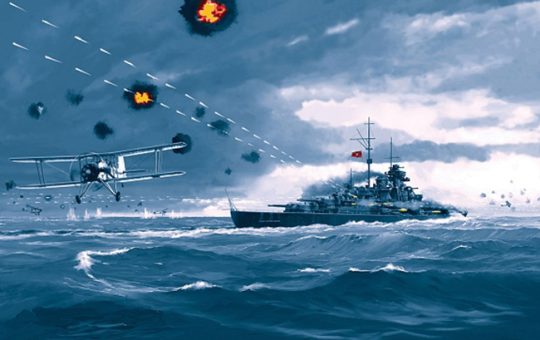
Fortunately, that night the Swordfish torpedo-bombers found and attacked Bismarck, with Terry Goddard’s aircraft the last to go in. “The flak is bursting over our head,” recalled Terry, “the small arms fire is pretty well all around us – and hitting us every once in a while – but we get in to drop the torpedo…do a quick turn away. Looking back shortly after the turn I see a large black and white explosion on the Bismarck. It is high and wide. Obviously, it is a torpedo hit. There is no other aircraft anywhere near us and there is no doubt it was the torpedo we had just dropped.”

Swordfish torpedo-bombers from HMS Ark Royal attack Bismarck on the night of 26 May 1941. Artwork by Dennis Andrews.

It isn’t the key hit – that has already been delivered via another Swordfish, in Terry’s view by Ken Pattisson’s Swordfish 2A – with Bismarck’s steering so badly damaged she stands no chance of reaching safety in Brest on the French Atlantic coast.

The British naval aviators could feel well satisfied. There was now a solid chance for the Royal Navy to avenge the loss of 1,415 shipmates killed just over two days earlier when Bismarck’s gunnery blew apart battlecruiser Hood.

For many of the men in warships scattered across the Atlantic – all heading towards a showdown with the Nazi high sea raider – it was a deeply personal mission. Many of them had known sailors and marines serving in Hood. A good few of them had at one time even served in Hood themselves. Now, crippled following a torpedo hit courtesy of the Ark Royal strike, the Bismarck was a mortally wounded beast that needed to be finished off.

The battleships of the Home Fleet – HMS King George V and HMS Rodney – were still steaming hard for the scene and, along with the RN’s heavy cruisers, would make their attack in the morning, secure in the knowledge that their quarry could not get away before then.

HMS Cossack, which led the 4th Destroyer Flotilla during the Bismarck Action. Photo: Courtesy of the HMS Cossack Association.

In the meantime, Capt Vian’s ships would harass and seek to further damage the German giant, with HMS Cossack leading the way for the destroyers’ attacks on the night of May 26. Ken Robinson recalled: “We went in head to sea and fired a spread of torpedoes. At the time, we thought one of them had hit.”

Having tried her luck, Cossack did not hang around, Ken remembering that his ship “turned and with the sea up our stern, sped away at what seemed to be the fastest we ever went, the sea throwing us all over the place.” German heavy shells plunged in around her, their approach seen on the destroyer’s radar but the Cossack got away without being obliterated.

• To read more of the story from the band of brothers who took on the German battleship in the finale, of 26/27 May 1941 read ‘Bismarck: 24 Hours to Doom’ published by Agora Books and available via Amazon as a e-book or hardcopy in the UK  and also the USA
• Iain Ballantyne tells the story of the Bismarck Action from various points of view across three of his books – ‘Bismarck: 24 Hours to Doom’, ‘Killing the Bismarck’ and ‘HMS Rodney’ (the latter two published by Pen & Sword). All three convey the stories of people in the big ships, along with major twists and turns, while also providing the perspective of destroyer and cruiser sailors, along with aviators. More information on Iain Ballantyne’s books here.

Confrontation at sea as U-boats deploy despite German surrender

Iain Ballantyne tells the story of a little-known confrontation between Allied warships and U-boats that took place off the coast of Norway some days after the official end of the conflict in Europe.

When VE Day fell, Lieutenant Commander Nicholas Monsarrat – who had seen a great deal of convoy escort work in the conflict – thought it a strange kind of finale for men who had fought so hard and for so long.

He would later sum it up in his famous novel ‘The Cruel Sea’ as follows: ‘…all over the Atlantic, the fighting died – a strangely tame finish, after five and a half years of bitter struggle.’ There were ‘no eleventh hour death or glory assaults’ or even post-surrender acts of piracy by the U-boats. According to Monsarrat ‘the vicious war petered out in bubbles, blown tanks, a sulky yielding, and the laconic order: “Follow me”.’ Tensions did exist, however, and there were U-boat commanders who seemed reluctant to follow the instructions of the victor.

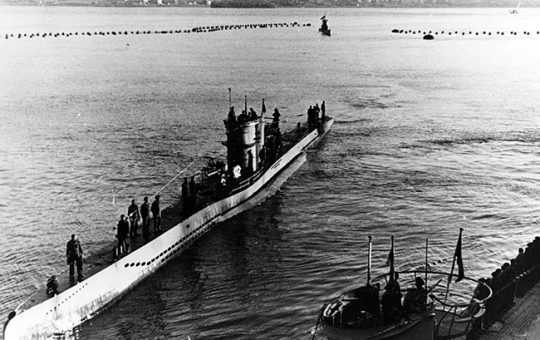
A U-boat returns to Narvik during the war. Photo: NHHC.

For some days after the official end of hostilities there was anxiety that fighting could erupt again at sea, which wasn’t surprising, given that the Battle of Atlantic had raged for six years, from the conflict’s very first days in 1939 until its last moments in 1945.

A tricky turn of events came when a group of U-boats, along with five surface ships set sail from their base in the Arctic, just as the last Allied convoy to Russia was underway. Convoy JW67 had departed the Clyde on May 12, and was due to reach the Kola Inlet on May 20. Its 23 ships had a close escort from the 4th Escort Group (4th EG) along with the carrier HMS Queen, while Commander Arthur Layard’s 9th EG was providing back-up at a distance. On May 14 the 9th EG was diverted to intercept the U-boat group. Royal Navy veteran Layard was the right man to handle the situation. Between July 1941 and 1945 he had served almost continuously at sea, much of the time as the commander of Royal Canadian Navy (RCN) escort groups, like the 9th EG.

Having fought off U-boats during the ferocious SC 94 convoy battle in August 1942, by spring 1943 he was leading the 9th EG, with the River Class frigate HMCS Matane as his command ship. On April 22, 1944 she sank U-311 to the south west of Iceland, with assistance from HMCS Swansea. After action in the Channel as part of the anti-submarine screen for Normandy invasion shipping Layard’s group was assigned to protecting Arctic convoys.

Layard had received an Admiralty signal, saying Norway-based U-boats were preparing to formally surrender, having been told to cease-fire by Kriegsmarine boss Grand Admiral Karl Donitz, who had succeeded Hitler after the latter’s death on 30 April. Donitz knew some of his U-boat captains would instinctively object to any order to hand over their submarines to the foe, preferring to scuttle them.

The unconditional surrender of Germany had been declared on 8/9 May and five days later the Royal Norwegian Navy destroyer Stord sent a message about the convoy of German vessels – five ships and 15 U-boats – deploying from Narvik, apparently heading south for Trondheim. Stord sent a signal to the Admiralty in London asking if this was permitted and so Layard’s group was ordered to intercept the U-boats and take them to Loch Eriboll on the north coast of Scotland.

Two German type VIIC U-boats meet in Arctic seas during a convoy hunt at the height of WW2. Their captains confer by megaphone prior to resuming the search. Photo: US Naval History and Heritage Command (NHHC).

‘It put us in a flat spin of course,’ confessed Layard. ‘By 14,30 we had formed up and began heading for Trondheim.’ The escort ships were heading into a gale, but still managing 17 knots. In the early hours of 17 May Layard was wrestling with nagging anxiety that the Germans might reach Trondheim before they could be intercepted and diverted to Scotland. ‘…the mist dispersed,’ recalled Layard, ‘and there was excellent visibility when the sun rose at 04.00. We sighted mountain tops at about 40 miles but found the land difficult to identify.’

Submarines might not be easy to identify against such a backdrop, but at 05.30 the German convoy was sighted. The 15 U-boats were on the surface in company with two repair ships, a command vessel, an accommodation ship and a tanker. Now came the difficulty of ascertaining the U-boats’ intentions. ‘We went to action stations as we approached,’ recalled Layard. The captain of HMCS Matane, Lieutenant F.J. Jones, was in no doubt about his ship’s readiness, for her men ‘were ready to blast them out of the water’.

  • To read what happened next, order the June/July 2020 edition of WARSHIPS IFR, which offers the full story of this episode. To get the magazine sent direct as hard copy or digital edition subscribe here.
  • Iain Ballantyne writes about submarine warfare history, including the contest between U-boats and Allied escorts during WW2, in his book ‘The Deadly Trade’ (W&N)  which has been published in the USA as ‘The Deadly Deep’ (Pegasus Books)


‘A powerful portrait of the fighting in the Streets, houses, gardens and woods’

Jan Loos was a 14-year-old schoolboy in Oosterbeek, the village on the outskirts of Arnhem town that saw much combat between British Airborne soldiers and their German foes in September 1944.

Like thousands of other civilians, Jan took refuge with his family, friends and neighbours in the cellar of a house that became the focus of a bitter struggle.
Shot at during forays from the cellar to get water, he was wounded in the leg.

In the immediate aftermath of the battle Jan and his family were forced to flee their ruined neighbourhood. At one point they came under attack from Allied aircraft that mistook a column of refugees for retreating enemy troops.

A soldier of the 1st Airborne Division takes aim at the enemy from the ruins of a house in Oosterbeek. (Photo: AWM)

After the war Jan became an aviator in the Royal Netherlands Navy and today furthers the cause of commemorating the Battle of Arnhem by giving tours of the streets in Oosterbeek where some of it took place. He explains what happened there during the battle, including recalling his own experiences.

Jan’s incredible story features in ‘Arnhem: Ten Days in The Cauldron’ which uses his own day-by-day recollections of the fighting as part of the narrative. Naturally, Jan was one of the first to receive a copy of the new book, by way of thanks for his help to ensure it offers a compelling read. This is his reaction to it.

“This weekend I finished reading Iain Ballantyne’s book ‘Arnhem: Ten Days in The Cauldron’ and felt as if I had relived the entire battle again,” said Jan.

“The way in which it so vividly and exactly describes how those of us caught up in the battle experienced the horrors and suffering of war reflected so well what it was really like.

“I was impressed by the way Iain managed to insert all the different stories from soldiers and civilians in an authentic setting and was pleased by how my own story intermingled with the stories of others who were there, to make a powerful portrait of the fighting in the streets, houses, gardens and woods. I congratulate the author on a job well done.”


Archive by month

Archive by year